
LST-1 Detects Very High-Energy Emission from the Crab Pulsar
22 Jun 2020
Between January and February 2020, the prototype Large-Sized Telescope (LST), the LST-1, observed the Crab Pulsar, the rapidly rotating neutron star at the centre of the Crab Nebula. The telescope, which is being commissioned on the CTA-North site on the island of La Palma in the Canary Islands, was conducting engineering runs to verify the telescope performance.
Pulsars are very rapidly rotating and strongly magnetized neutron stars that emit light in the form of two beams, which can be observed from Earth only when passing our line of sight. While detecting the strong and steady emission or outbursts of gamma-ray sources with Imaging Atmospheric Cherenkov Telescopes (IACTs) has become routine, pulsars are much more challenging to detect due to their weak signals and the typical dominance of the foreground gamma-ray signal from the surrounding nebulae. Despite hundreds of observations hours by IACTs around the globe, only four pulsars emitting signals in the very high-energy gamma-ray regime have been discovered, so far. Now that the LST-1 has shown that it can detect the Crab pulsar, it joins the field of telescopes capable of detecting gamma-ray pulsars, validating the timestamping system and the low-energy performance of the telescope.
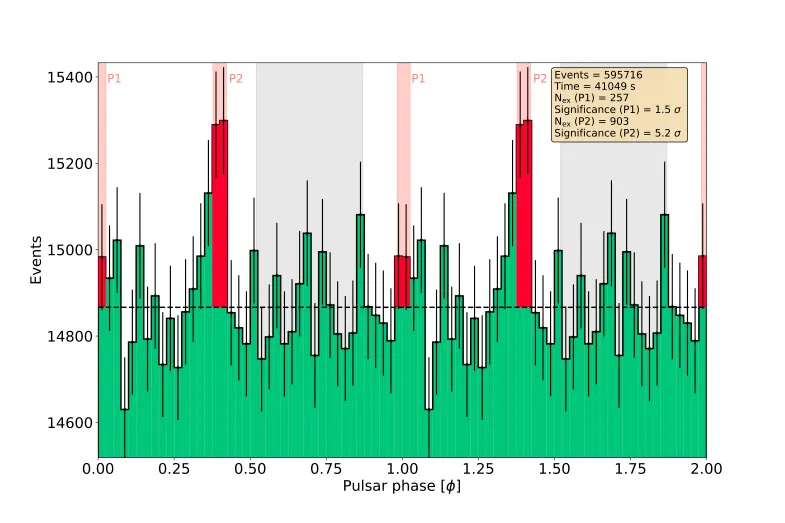
The data set collected includes 11.4 hours from eight observation nights. Figure 1 shows the resulting phasogram, plotting the gamma-ray events as a function of the pulsar rotation phase. In the phase regions marked as P1 and P2, more gamma rays are expected as the Crab pulsar emits towards the Earth. The emission detected in all phases (marked green in Figure 1) is a mixture of different background contributions, including the irreducible steady emission from the Crab Nebula. The signal detected with the LST-1 (marked red in Figure 1) is undeniably significant for phase P2, while the signal during P1 is still marginal. The animation in Figure 2 highlights the pulse behaviour of the source during the different phases.
Further information about the Crab Pulsar detection can be found below: CTA Prototype LST-1 Detects Very High-Energy Emission from the Crab Pulsar